mirror of
https://github.com/jbranchaud/til
synced 2026-08-31 16:51:46 +00:00

46 lines
1.7 KiB
Markdown
46 lines
1.7 KiB
Markdown
# Convert Arbitrary Number To Probability With Sigmoid
|
||
|
||
A sigmoid function is a useful function in statistics and machine learning for
|
||
converting a number in the range of positive and negative real numbers into a
|
||
value between 0 and 1. Sigmoid functions can be a bit more diverse than this,
|
||
but this is a good basic definition.
|
||
|
||
Wikipedia defines another characteristic of sigmoid functions:
|
||
|
||
> A sigmoid function is any mathematical function whose graph has a
|
||
> characteristic S-shaped or sigmoid curve.
|
||
|
||
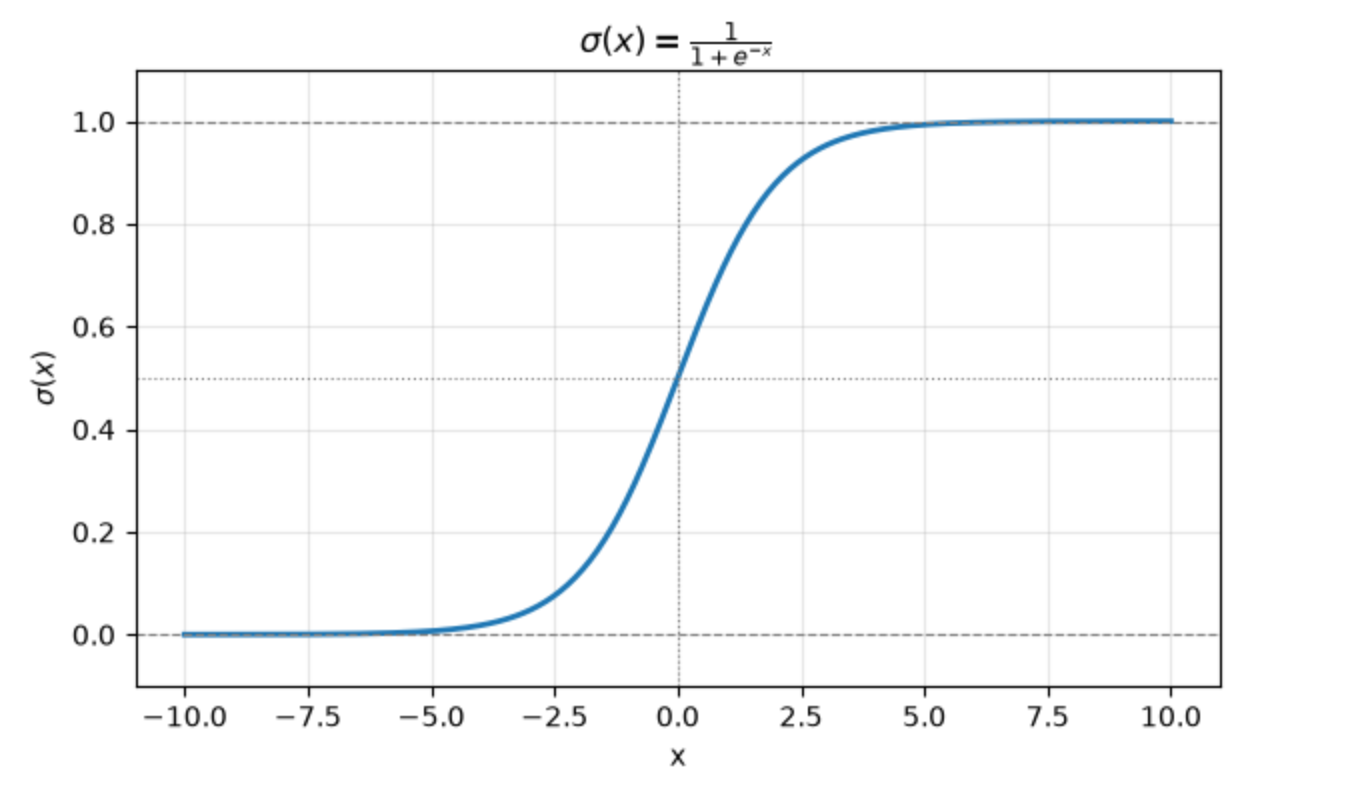
This S-shape is because it is asymptotic at the ends allowing it to cover all
|
||
real numbers in either direction.
|
||
|
||
A common sigmoid function and the one used by [PyTorch's `Sigmoid`](https://docs.pytorch.org/docs/2.13/generated/torch.nn.Sigmoid.html)
|
||
is this exponential form -- `σ(x) = 1 / (1 + exp(-x))`.
|
||
|
||
Here is what this looks like plotted on a graph:
|
||
|
||
|
||
|
||
This function can be used any time we want to convert an arbitrary number into a
|
||
probability. Large negative numbers will approach 0. Large positive numbers will
|
||
approach 1. Numbers near 0 will settle somewhere in the middle.
|
||
|
||
Here are a few examples run through PyTorch's `sigmoid` function:
|
||
|
||
```python
|
||
print("σ(-99) => ", torch.sigmoid(torch.tensor(-99.0)))
|
||
print("σ(99) => ", torch.sigmoid(torch.tensor(99.0)))
|
||
print("σ(0.123) => ", torch.sigmoid(torch.tensor(0.123)))
|
||
print("σ(-2) => ", torch.sigmoid(torch.tensor(-2.0)))
|
||
print("σ(1) => ", torch.sigmoid(torch.tensor(1.0)))
|
||
```
|
||
|
||
which prints out:
|
||
|
||
```
|
||
σ(-99) => tensor(0.)
|
||
σ(99) => tensor(1.)
|
||
σ(0.123) => tensor(0.5307)
|
||
σ(-2) => tensor(0.1192)
|
||
σ(1) => tensor(0.7311)
|
||
```
|